Mirror neurons and Emotion Recognition
How emotions can affect the conduct of interviews. Does building relationships affect their effectiveness? How mirror neurons determine the mutual interactions of interviewers and participants. Does introducing behaviors based on pressure make sense?
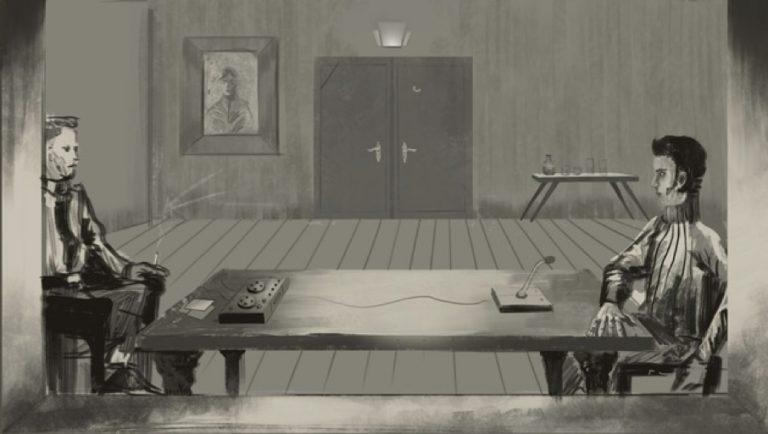
“Go on, Tadziu.” “The boy opened the door and went in first.” The officer stopped him with a calm gesture of his hand. He needed details. And tell me what the boy looked like? He asked. “I can’t describe his appearance. He was small.” “And what were you wearing?” “I don’t remember, I only remember that it was warm that day.” (…) “Go on.” “I took a towel from the bathroom, twisted it so that it was thick, went up to the boy, knocked him down, pressed him to the floor and then put the towel around his neck and tightly tightened the noose I made at the back.” “Did the boy say anything?” “I don’t remember, it happened so quickly.” “Did you rape him?” “No, I’m telling you the truth, Commissioner.” It was true, the Commissioner just wanted to see how Kwaśniak would react to such suggestions. He wanted to examine him, get to know him. Interrogation is a kind of cognitive experiment. You release signals, stimuli and check the effects. The record of the interrogated person’s reaction is important: it is not only the language that counts, but also the body language.”
A fragment of the book by W. Ciszak and M. Larek: ‘A Man in White Boots’.
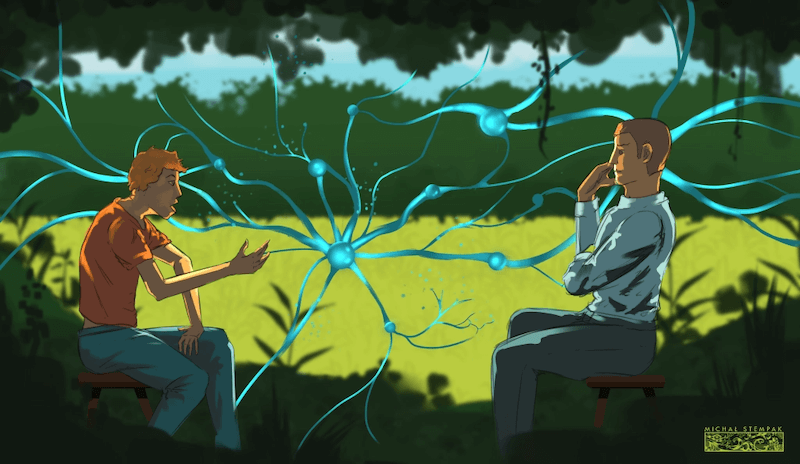
Interviews are fascinating! Their course consists of complex interactions between the interviewer and the interviewee. It involves mutual understanding of intentions, communication styles, and approaches to conversation, as well as the ability to sense the current mood. Behaviors, including the quality of information conveyed by the participant, significantly depend on how the interview is conducted. On one hand, the interviewer tries to maintain control over the appropriate course of the conversation, while on the other hand, the participant seeks to achieve their own goals, whether consciously or not. The transmission of emotions and feelings between individuals remains one of the more important mechanisms of our brain’s functioning, but of course, this is not true for everyone, and each of us has different skills in this area. It allows for a relatively quick assessment of the situation (how threatening it is), which in turn enables an effective reaction in case of danger. If one person displays a positive attitude or excitement, another may interpret it as a signal of emerging possibilities for good communication. Empathy occurs thanks to mirror neurons (MNS – mirror neuron system), discovered in Parma by Italian researchers Giacomo Rizzolatti, Leonardo Fogassi, and Vittorio Gallese. They are located in the frontal lobes, much like motor neurons that stimulate movement. The difference is that motor neurons activate when we perform an action, while mirror neurons also activate when we see others performing that action. They play a significant role in mimicking others and learning based on observation, taking into account the perspective of another person. Observing and understanding others through these neurons has thus become a common phenomenon, and it is suspected to have significantly influenced the development of humanity (replicating effective behaviors). It is estimated that about 20% of motor neurons are actually mirror neurons, including those responsible for empathy. These neurons, for example, allow us to empathize with the emotions of a person in physical contact with another person without consciously experiencing the contact (which may explain the success of Brazilian soap operas). In other words, thanks to these neurons, we can recognize the emotions and intentions of others expressed non-verbally. Moreover, our brains are well-prepared to recognize faces and their emotional states. Throughout evolution, this mechanism has aided in recognizing not just individuals, but also their intentions; in many situations, this function is incredibly helpful even today. During evolution, the speed of intention recognition was often a critical factor in survival, allowing for the adoption of an appropriate strategy – whether to fight, defend, or flee.
What practical applications does this knowledge have in conducting interviews? It seems significant due to the specific nature of relationships between the participants—sometimes conflicting goals, clashes of different personality types, or differences in temperament. Below, I present four aspects that empathy significantly influences and that may determine the final outcome.
Building relationships. Even the first few seconds can tell the participant about the interviewer’s attitude. Their mind will often mirror the emotional states of the interviewer, and behaviors and reactions will be responses to these states. If the participant perceives the signals as negative, they will react similarly—with a lack of openness or nervousness. Conversely, participants experienced in difficult communicative relationships will seek and test various strategies to change the interviewer’s attitude. This, in turn, will decide the course of the interview, the quantity and quality of information gathered, but most importantly, the final decisions or opinions.

Reading intentions. If a participant has the ability to read the intentions of the interviewer, they can very quickly develop a change in the communication strategy and response. For example, detectives are masters in recognizing emotional states (including deeply hidden ones). They often interrogate intelligent criminals who know perfectly well how to hide or fake emotional states, which help them, for example, to make the stories they tell more credible. Even unconsciously showing disapproval or a negative attitude with their facial expression will result in the effectiveness of obtaining information. Unfortunately, it happens that some interviewers show their true face during interviews, which they present in everyday, professional and non-professional situations. An example would be showing signs of impatience, wandering eyes or statements of an attacking nature.
Positive and negative assessment of statements. People less experienced in conducting interviews more often show signals of disapproval that are beyond their conscious control. The video recordings that I play after the interviews show (to the surprise of the interviewers) a multitude of reactions that clearly indicate a positive or negative assessment of the statement. Such signals include clearing the throat, head movements, smacking lips, a sudden tilt of the torso or straightening. Of course, it is only visible on the recordings that these reactions occurred in a specific context of the statement and are not accidental. It rarely happens that before playing the recordings someone is aware of such reactions. The perception of the interviewee during the interview is sharpened, the mind in such a state turns on a set of stress reactions. Especially in people who are rarely interviewed, there appears, among others: racing thoughts or no thoughts, searching for many alternative answers, fear of another negative assessment or gaps in memory. Additionally, physiological reactions make themselves felt: redness of some areas of the body, speech errors, stuttering or dry throat. A feedback mechanism appears: the brain reads the threat signals coming from the body and becomes even more stressed. This again leads to an increase in the level of adrenaline secreted by the adrenal glands, and after several minutes of a stressful situation – cortisol.
Influencing testimonies and relationships. During interrogations, clinical or court interviews, participants sometimes succumb to the influence of the interviewer. As research shows, in the British Home Office, interrogators often use a style based mainly on persuasion techniques. Studies conducted by Tali Sharot, Micah Edelson and Yadin Dudaim, among others, have shown how significant the level of influence of other people on memory can be. The participants of the study were asked to complete a survey after watching a film. After a few days, they were asked to complete the survey again, but this time they were presented with the answers of other participants. When completing the survey again, 70% of the respondents changed their answers on quite key issues. The third version of this act was interesting, when the respondents were told that some of the answers of other participants had been deliberately falsified, but on insignificant topics. The corrections they were supposed to make should not have been significant. It turned out that, firstly, the subjects clung to incorrect answers, and secondly, they denied that they had been influenced by false information.
This type of situation, when others influence our judgments (learning other people’s answers), triggers the amygdala, which processes emotions and social behaviors in our brain. The amygdala communicates with the hippocampus, which is responsible for, among other things, creating memories and transferring them from short-term to long-term memory. Information about falsified results activates the frontal lobe, where rational thinking or decision-making comes into play. If the amygdala reacts strongly to the emotions of others, it turns out that the frontal lobe is turned off, which causes us to succumb to the influence of others.
Regardless of the lengthy explanation from the physiological level, it is important for the presenters that the intensity and scope of persuasion methods affect how quickly and with what effect someone will change their testimony. Unfortunately, not necessarily in a way that will lead to reporting the situation in accordance with the facts.